

One of the most common sentences I hear from women about anxious reactions: “I just have to stop it.” This sentence is the reason we keep suffering and staying in the loop of anxiety. One of the BIGGEST misconceptions about any challenging emotion is that it’s ‘bad’ and we must fix it as soon as possible. From Yoga’s point of view – there is no ‘good’ or ‘bad’ and that includes anxiety.
ANXIOUS REACTIONS CAN LOOK LIKE…
Trust me, I know how much anxious reactions suck…
🧠 Wake up in the middle of the night and the mind thinks it’s an invite to start ruminating.
😭 Something challenging happens in your day and it feels like the rest of the day is ruined.
🌀 Not feeling good about an interaction and your mind keeps replaying it over and over again trying to find a different result.
😬 You’re on vacation and it takes days for your mind to let go and relax.
🔮 Trying to control what happens in the future by imagining as many scenarios as possible.
A mind that just won’t shut off creates tension in the body. Makes it difficult to breathe. Leaves sweat marks on your favorite shirt. Won’t let you just sit, relax and enjoy the present. Keeps you from being able to focus on the positives around you. Creates regret after you’ve snapped at the people you love most.
All of these things keep happening because of the belief ‘I just have to figure out how to stop anxiety.’
WHEN I TRIED TO FIX AN ANXIOUS REACTION
One anxious reaction that woke me up 16 years ago is still clear in my mind. It was 3 am, my mind had been ruminating over an adolescent client who had a challenging home situation and was making harmful choices despite having so much potential.
This was at the beginning of my career as a mental health therapist. My ruminating mind was trying to find the one thing that could ‘fix’ things for her.
Then it happened…
I sat straight up in bed with the solution. It was all I could do to keep myself from going to the office to call her and let her know. Luckily, I knew better than to let that urge manifest into action at 3am. I somehow calmed myself and finally fell asleep.
When I woke up, I had no recollection of that perfect ‘solution’ and I was exhausted.
My mind was doing what all minds do best – think. And it was doing its basic job to protect me from the uncomfortable emotion of feeling powerless in changing this girl’s situation. As her therapist, I could listen, support, and go over options…
But she was going to make her choices.
It was a good lesson that reminded me:
📌 I don’t have control over my client’s lives,
📌 My mind can’t think its way out of a situation it has no control over,
📌 And if I didn’t find another way of doing things, I was going to burn myself out.
My mind wanted to stop feeling powerless because it can be a really uncomfortable place to be. But fighting it or trying to escape what is happening, doesn’t change what is happening.
FIXING ATTITUDE CREATES MORE ANXIOUS REACTIONS
Unfortunately, this is what most of us have been taught – to fight, ignore, escape, or fix how we are feeling. Treating anxious reactions this way makes it ‘bad’, ‘wrong’, and ‘the enemy.’ Since anxiety is an emotion and emotions are part of being human, when we believe anxiety is something to get rid of we are actually making part of ourselves the enemy. Most of us are at war with anxiety (and many other uncomfortable emotions).
But, we can’t escape ourselves…even though we try. We do this by trying to seek pleasure to ‘forget’ and ‘distract’ from anxious reactions. In the end, the anxiety stays stuck in our bodies, we have a negative relationship with ourselves, and are exhausted from the effort we waste in this pattern.
And poor anxiety…It’s just trying to get our attention and communicate to us. But we are too busy in our war against it to hear. (Sounds a lot like what’s happening on a national and global level too.)
ANXIETY IS A SMOKE ALARM
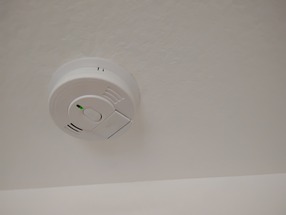 I have found it’s helpful to think of anxiety like a smoke alarm.
If you watched someone react to a smoke alarm by beating it, throwing it out the window, yelling at it while smoke is billowing around them – you’d think they were crazy, right? Well that’s what we are doing with anxiety. Instead of taking time to get curious about why the smoke alarm of anxiety is going off, we are trying to get rid of it. Thus, we are missing the whole point of this amazing emotion!
TRUST AND FAITH DECREASE ANXIETY
Turning to Yoga, I am reminded about renunciation. In the Bhagavad Gita, Chapter 18.7-9, the Divine teacher, Krishna, teaches that renouncing actions that must be done is not recommended. True renunciation is working to let go of desires for a specific outcome. When we focus on trying to control outcomes (Which, BTW, are out of our control), many times fear is the mindstate those actions are coming from. When we take actions from fear, it just tends to feed the fear.
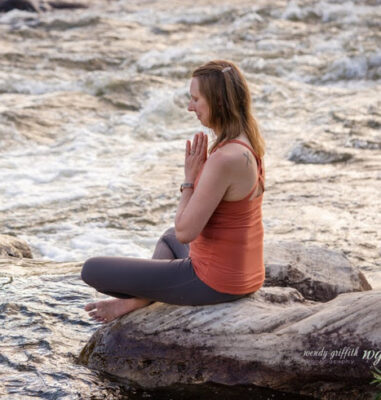
Photo by Wendy Griffith Photography
In order to let go of anxiety, we must put energy and action into cultivating more trust and faith. The beautiful thing about this is anxiety can be used as a partner in this process. Can you imagine what might happen if you put the energy you use to try to stop and ‘fix’ anxiety into cultivating more trust and faith, what would be different in your life?
FAITH CAN BE A RESISTED WORD
I know for some the word ‘faith’ carries a lot of resistance. To live more of a loving life, a life filled with more compassion and kindness, faith is necessary. Faith is having trust and confidence in someone or something. On a higher level this is having faith in something greater than ourselves. This may be God for you. Or it might be faith in an underlying connection of all things, unconditional love, or pure consciousness.
If it works better for you, think of the word trust instead. Start with where you are at. Do you trust in a higher power, yourself, or a spiritual teacher? Whatever resonates most with you, start there.
Whenever anxiety shows up, remember that anxiety is communicating to you that you are not connected to trust and faith. It is something to listen to and understand so you can find clarity in what actions to take with the intention to build towards increasing trust and faith.
This has been an area I’ve personally been working on for the past decade. With consistent practice, it’s been amazing to see as my trust and faith increase, anxiety decreases.
3 MINDSETS TO USE WITH ANXIOUS REACTIONS
The practice of renouncing or letting go is not about stopping an activity. Yes, you can do this, but anxious reactions will inevitably pop up elsewhere. This is because it all starts in the mind. The mind is where the change needs to happen. That change is letting go of outcomes. Do your actions and let go of trying to control the outcome.
The top 3 mindsets to incorporate into your daily life to let go of outcomes are:
- Focus on what YOU can control.
- Bring the mind back to the present.
- Cultivating contentment and gratitude for where you are at…since this is exactly where you are supposed to be.
I would encourage you to list all the tools and techniques you have in your tools box that help you with these three practices. Then choose one or two, that’s it, and start practicing these every day. Until they happen without effort on your part, i.e. they’ve become your habit.
You don’t need more tools…
You need to use the tools you have that already work in one-off situations. Now, it’s time to commit to using them so they can transform the anxious mind to one that is full of trust and faith.
 Shanti.
P.S. These 3 mindsets are part of what I teach in my 3-month, online program: The Inner Roadmap™ Program. If you’re curious to know more, let’s chat! Schedule a Connection Call with me anytime.