
Jenna Schauer and I met a number of years ago when a common friend put us in touch. At the time, we were both facilitating groups on Chronic Pain. My group was for people struggling with mental health issues due to chronic pain. For Jenna, her patients came from the physical therapy clinic where she works. Her participants’ chronic pain wasn’t improving with medical interventions. In essence, we were seeing the same population.
We met up for coffee to share what we were each doing in our groups. We found the common ‘tool’ we both were using was the breath. I had been integrating the breath in my work as a mental health therapist from my training as a Yoga teacher. Over and over, I was finding that just simply teaching my clients breath awareness decreased both mental and physical suffering around pain. No matter if the pain was physical or emotional.
YOGA AND PAIN
From a Yoga perspective, pain is part of life. It’s impossible to mitigate all pain but it’s not something to fear either. Pain is actually an amazing teacher for those who are able to change their relationship with it from an ‘enemy’ to an ally. Over millennia, many people find their way to Yoga from a desire to reduce suffering in life. All the practices that come under the Yoga ‘umbrella’, are tools to move us towards this freedom. What ancient Rishis (spiritual masters) found was the key to reducing, and even being completely free from suffering, is moksha or Self-Realization.
This ‘goal’ can seem so far away when we are in pain. Pain can hijack our mind’s ability to think clearly and find balance and harmony. We usually aren’t concerned with spiritual goals when all we want is relief. We just want to get back to ‘life as normal’ and get some sleep. What’s fascinating to me, is that as the scientific research continues unfold – the ancient wisdom from Yoga keeps being validated. Its wisdom and practices are as relevant today as they were two thousand years ago.
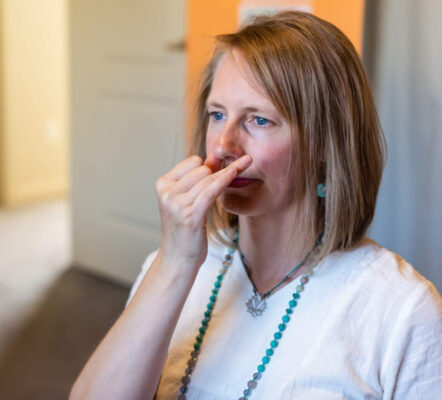 Let’s go over an example of how science and Yoga meet through breath. Breath is the gross and more tangible form of what is referred to as prana or lifeforce in Yoga. Breath has been used for millennia as a way to focus and calm the mind in Eastern cultures. Only a calm, steady mind is fit to do the inner investigation necessary to understand the True Nature of Self. A wonderful ‘byproduct’ of breath awareness and many breathing practices is regulation of moods, increase focus and energy, and relaxation of the body.
MODERN SCIENCE AND BREATH
This understanding of the ‘byproduct’ of breath awareness and breathing techniques, didn’t make its appearance in modern medicine until the 20th century. Yes…only in the last 100 years. So using breath as a medical and psychological intervention is, relatively, ‘new’. Especially when compared to how long it’s been used in medicine in India. Konstantin Pavlovich Buteyko was a name I came across when researching the history of the breath in medical practice. He was a Ukrainian doctor who observed differences in the breath with those who were sick and dying versus those in recovery. His own health issues allowed him to try out his curiosities by seeing what happened when he changed his breathing patterns. Amazingly, it helped change the course of his symptoms when other treatments did not. His health issue – hypertension. This was in 1952.
I also came across oxygen therapies for respiratory care that were published by the newly formed Inhalation Therapy Association in 1947 – “Manual Of Oxygen Therapy Techniques.” These medical professionals working from the goal “to help others breathe.” Though just a bit earlier than Buteyko, the focus was on ways to externally increase oxygen levels in the body, rather than it being about using the breath to change symptoms
80 years later, there now is an extensive body of research on breath awareness and changing the breath for health purposes. And it continues to grow. From MBSR research based on Jon Kabat-Zinn’s mindfulness awareness model to James Nestor’s book, ‘Breath: The New Science To A Lost Art.’ But what I find is the perspective that continues to prevail in regards to using the breath is that it’s a quick fix to ‘feel better’. This doesn’t shift beliefs and understanding about Self. So, most people chase keep chasing after’ feel good’ moments, instead of breath being integrated into a whole different way of viewing pain and suffering.
THE SCIENCE OF YOGA
 Yoga practitioners from times past didn’t have the technology we have today. They made use of the resources they had at hand to make their discoveries. In their pursuit to understand the root cause of suffering in life, they used their own body and mind as the laboratory. Their ‘tools’ were their own self-study, exploration of spiritual knowledge, and observations of the world. Their exploration led them inward where breath happens. Then deeper into even more subtle observations of life force beyond the breath.
As science continues its investigation to more subtle realms, it would not surprise me if they reached similar conclusions that were discovered by those ancient practitioners of Self.
PAIN – A PERSONAL EXPERIENCE
Bringing it back to pain and suffering…
Yoga’s ‘conclusions’ about suffering are that the root cause comes from the mind. Pain itself is a communication response of the mind-body complex to signal that there’s been a disruption in the body. It does this to alert us that something needs to be investigated. Suffering, on the other hand, comes from the interpretation of pain in the mind. The mind takes the data its gathered through our senses about pain to make sense of things. By ‘senses’ I mean what we see, hear, smell, taste, and feel on the skin, as well as experience through emotions and thoughts.
The interpretation of pain is highly individualized based on a person’s prior life experiences and biological makeup of a person’s body. It’s why one person to one person a splinter may cause tremendous pain and another person continues to function despite a broken bone or other major injury. Suffering is the output of the mind’s perspective about pain. It is not necessarily congruent with the body’s chemical pain response.
ANCIENT YOGA TEXT FOCUSES ON REDUCING SUFFERING
A well-known Yogic text, the Bhagavad Gita, is based on the suffering of one of the main characters, Arjuna. He is experiencing a ‘nervous breakdown’ or anxiety attack in the moments leading up to a battle of epic scale and consequence. His suffering is stimulated from asking his charioteer, Krishna – the other main character, to take him to a better vantage point to view the other side whom he’s about to engage in war. He sees family, mentors, and friends on that other side and feels emotional pain at the thought of killing and losing those he holds dear and in high esteem.
Those thoughts send him into grief, confusion, and depression. He collapses onto the floor of his chariot, refusing to engage in the actions of a warrior.
I love the Gita because Arjuna’s reaction is highly relatable as a human being. How many times have you been going about your day, doing fine and then everything changes? A word, a look, tone of voice, a smell, or some other stimulus in your environment creates a cascade of reactions that throws you into misery.
COMING HOME TO A DARK APARTMENT

Photo From Unsplash
As someone who practices self-awareness and self-inquiry every day, I continue to be fascinated by watching this happen to my mind over and over. Last night, I came home after going out to dinner with some friends. My apartment was dark and exactly as I had left it. This meant Greg had not been home yet. Immediately, I watched my mind react as it tried to figure out where he was at. My expectation as I opened the door was to find evidence that he was at home or had been home. I had expected to feel connected to him…instead I felt disconnected.
I very easily could have spun into worry if he was okay. Or into anger that he didn’t communicate his plans after work with me.
Instead…I immediately became aware of my breath and slowed it down. I witnessed the reaction in my mind. I looked at the time – 6:00pm. He was most likely finishing up his workout at the gym. I noticed I felt impressed that he made exercise a priority after work to take care of himself. From that space, I put my things away and went on with my night. My moment of potential suffering ended.
ADD IN PHYSICAL PAIN…
Now, if I had been having some back pain when that initial reaction happened, things might have been different. The tightness of my muscles that would have accompanied worry or anger had I continued with my initial reactions, most likely would have increased that pain. I know this is a possibility with my reactions when I’m in physical pain because I have experienced it many times before. That increased pain would have fed into my spiraling stories. In fact, my mind very likely could have taken it another step further and blamed Greg for my back pain in some way.
This cascade of an initial reaction into a full blown story of ‘what ifs’ created in the mind can wreak havoc on pain. But being able to find just a tiny bit of space between the initial reaction and the spiral can keep this from happening. In my personal example, awareness, breathing, and curiosity calmed my initial reaction. It allowed me to stay present and find clarity of the reality of the situation so I didn’t suffer.
LET’S EXPLORE PAIN AND SUFFERING TOGETHER
It’s easy to say – ‘just be aware, breathe, and get curious’ – to meet pain and suffering…
But the practice of it can be remarkably challenging. Trust me I know. I’ve been practicing sincerely for well over a decade now. And I’m grateful for that practice as it moves me away from suffering more easily every time I take action with it.
For those of you who are experiencing pain and suffering in your life now, whether you’ve started to or have tried using these three ‘tools’ or not…
AND if what I’ve shared resonates with you in some way (maybe a little itch in your mind or a big ‘yes’) – I’m excited to extend an invitation to dive deeper into the understanding and practice of reducing pain by addressing suffering.
I mentioned Jenna at the beginning of this blog post for a reason.
Jenna and I are facilitating a 5-series online workshop to FIND A FRIEND IN PAIN, starting December 2nd, 2025. We are bringing together her expertise of the body, my expertise of the mind and the place where we’ve joined – Yoga.
Jenna’s exploration to the breath from our first meeting, led her directly to Yoga and she is now also a Yoga Teacher and meditation facilitator. Funny how life unfolds.
Body, Mind, and Spirit will all be equal resources in this workshop series as we discover how changing your relationship with change can decrease your suffering.
We’d love to share more with you!
 Shanti.