

It finally feels like fall here on Jeju Island as the winds shift from the north bringing cooler air and breaking the humidity. Seeing all the amazing fall colors in social media posts from Colorado, I could feel the longing for change of season. Fall, even though it is the brilliant finale of life for leaves, it also signals the journey into shorter and colder days. It’s not uncommon to interpret this slowing down that happens in our bodies this time of year as ‘something wrong.’ Especially in a society that values productivity no matter the time of year. The perspective we have about change creates a huge part of our reality.
POSITIVE AND CHALLENGE OF CHANGE
For most of my formative years and into adulthood, I had a love-hate relationship with change.
On one hand, change was exciting!
Bright, new school supplies and reuniting with friends at the start of a new school year. Feeling the cozy warmth of long sleeves and jackets or shedding layers and feeling the warm sun on skin with the change of different seasons. Anticipation of adventure when embarking a different life journey. Opportunity to let go of old versions of self as new relationships blossom.
On the other hand, change is terrifying.
The ‘what if’ uncertainty that catapults the mind into flight or fight mode, even though it’s only thinking about change. Pulling you away from enjoying the present moment and seizing today. The mind works overtime to plot a course in that uncertainty it thinks will result in the least amount of pain. Facing fear through either overthinking or numbing out to stop the thinking.
Two ends of a spectrum whirling around like a tornado – Excitement and Fear.
But like a tornado…
Is there a calm center?
AN ANCIENT QUESTION
 Ancient Yogis wondered this very thing. They asked the question: How does one end this mental suffering?
One of the oldest surviving Yoga philosophy texts that addresses this question is the Sankhya Karika (SK), written sometime in the 2nd – 4th centuries CE.
One reason I share this is the suffering you feel in your life that comes from fear, excitement, and every emotion in between is normal. It’s part of being human. Humans have been trying to ‘feel better’ for millennia. Some have succeeded and have worked to pass down that knowledge.
But turning that knowledge into a reality in our own life takes practice.
A practice to decrease suffering in the mind should include the 3 As: Acceptance, Awareness, and Action.
ACCEPTANCE
In the very beginning of the Sankhya Karika, acceptance is addressed. Specifically, acceptance of pain as part of living and being human. This can be very challenging in modern times when there’s a lot of money to be had selling the belief that pain can be eliminated:
📌In 2021-2022, average annual spending on all outpatient prescription opioids totaled $3.5 billion. (1)
📌In 2020, over $15.6 trillion was spent on psychiatric medications. (2)
Yes, there is some pain that warrants medication. But these numbers, most likely, show what I observed many times in the mental health field – the money is to be had in medications, not therapy and case management to help with behavior change.
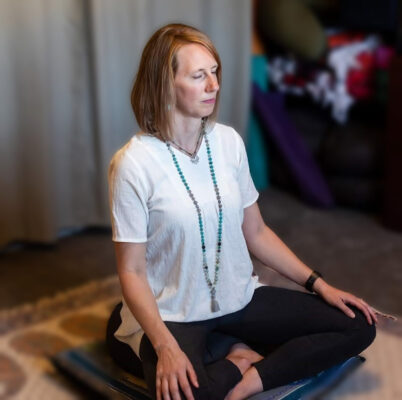 Also, and even more importantly, we have to take responsibility if we desire change in our mind state. How many times have you read or been told a lifestyle change that would change how you’re feeling…but you either try it for a week or so and stop after feeling better. Or, you decide ‘it’s just going to be too hard’ without even trying?
At the very basic level of survival, our body and mind are wired to avoid pain and seek pleasure. This is part of the challenge of making conscious change. All of us have deep patterns that we’ve been using for decades to manage pain, which are actually increasing the pain through mental attachments.
Even though change is challenging, it’s still possible. I’m talking about transforming habits from ones that limit you to ones that uplift you.
CAUSES OF PAIN
Back to the Sankhya Karika…
There are 3 causes of pain we experience as humans:
- Internal influences, i.e. the body and mind
- External influences, i.e. other people, animals, natural disasters, etc.
- Supernatural influences, i.e. energies unseen
Most external causes we have no control over. There are some behaviors we can take to minimize risk of painful experiences like not drinking and driving, getting annual health check-ups, and brushing your teeth. But, remember, pain can not be completely eliminated from any circumstance.
Where we have the most control over reducing pain is the place where suffering comes from – the mind. Suffering is a type of mind pain that comes from how we interpret or filter a situation.
A few years ago, I was driving from Gypsum, CO to Denver in the early summertime on I-70. I made it over Vail pass and was heading up to Eisenhower Tunnel when I saw brake lights up ahead. There had been an accident. I had no idea how much time it would take for traffic to get moving again. These were the facts of the situation.

Photo by Aayush Srivastava on Pexels
My mind started to wonder about where the accident was and how long traffic had been stopped. I tried to look up information but I was in a ‘dead zone’ for cellphone connection. Many times in the past when this has happened, my mind would have started to worry about contacting who I was going to see to let them know I was going to be late, focusing that I was feeling hungry with no food, and from there launching into ruminating about other worries my mind had in my life.
CHOICE
The mind loves using ‘downtime’ to think. Staying with this reaction would have most likely worked me up into a stressed out frenzy. I would have reached my destination focusing on my ‘stressed out’ story and the ‘horrible’ drive.
Instead, I took a breath in and a long slow breath out. ‘Well, how do I want to use this time?’ I decided to use it to enjoy where I was at, focus on breathing calmly and let go of thinking. Using my time in this manner led to feeling content and relaxed. Once traffic got going, I allowed myself to stop and eat, I continued to enjoy the drive and told my friends the drive was beautiful.
Same situation, different perspective. The suffering from the desire for things-to-be-different and fighting the situation was completely avoidable. All I had to do was change my view and attitude about what was happening. Simple in theory. It does take consistent practice over a long period of time for this to be the mind’s ‘go to’ habit. And I haven’t meant a woman who has put in the effort to say it wasn’t worth it. Instead, I hear, ‘Why didn’t I do this sooner?’
Accepting that pain is part of life and suffering is a choice is a game changer.
AWARENESS
The practice of letting go of suffering starts with awareness of your reaction.
In a given situation, what is happening with your emotions, thoughts, and body sensations.
As human beings, we are wired for social connection. Being born with female genitalia, we have been taught that part of our role as ‘female’ is to take care of others. Make sure not to hurt anyone’s feelings, make sure others are happy, and put ‘the other’s’ wellbeing in front of our own. Because of these factors, it’s very common when I first start working with women that:
- When I ask what’s positive and challenging in their week – they tell me what happened with others instead of themselves.
- They share thoughts instead of emotions and body sensations when telling me how they feel.
- Often when sharing, they say ‘you’, instead of ‘I’ when they talk about their emotional experiences.
Their awareness is external, not internal.
We can not change what we aren’t aware of. If you are wanting to change suffering in your life, which is caused by your perspective of a situation, you MUST learn what’s going on within you. And, doing it without judgement. These two actions alone can decrease suffering exponentially.
ACTION

Jess Bailey Designs on Pexels
Action simply means practice. Taking the action to accept what is happening in the moment and cultivating internal awareness requires practice. Over and over…and over.
What I often see is women will be motivated to practice for about 7-14 days. In that time, either they will start feeling better, so stop practicing. Or feel like they aren’t completely ‘better’ so declare ‘this doesn’t work for me.’ Here are a couple of interesting research results about building habits (and mind you these are physical habits, not thought habits, which are much more difficult to change):
📌A 2015 study found that new gym-goers had to exercise at least four times a week for six weeks in order to develop an exercise habit. (3)
📌A hallmark 2009 study on habit creation found that habits developed in a range of 18 to 254 days; participants reported taking an average of about 66 days to reliably incorporate one of three new daily activities—eating a piece of fruit with lunch, drinking a bottle of water with lunch or running for 15 minutes before dinner. (4)
This information is not meant to scare you away and think, “why bother.” Understanding why it takes time and effort, as well as why it’s normal to relapse, when cultivating new habits helps to create a different, realistic perspective. It can also help with being kinder and more supportive towards yourself.
I know when I go for a hike, being told ‘it’s not that far’ versus, it’s about a mile and a half with 400 feet elevation gain and will take about 40 minutes to an hour depending on your speed, makes a huge difference mentally.
BONUS TIP FOR SUCCESSFUL CHANGE
Another tip for actions to create change is having support when your motivation wanes or when you ‘fall off the wagon’. These things will happen. It’s normal. But when we have accountability and positive encouragement from others going through the same thing, it can make all the difference whether we are successful or not.
It’s a huge accomplishment to make conscious change with patterns in your mind!
Reflecting on the 3 As – which one do you need to make a priority for yourself?
 Shanti.
P.S. If you’re curious about getting more support with making changes around mental causes of suffering in your life, check out my workshop page or contact me to find out what I currently offer.
- Medical Expenditure Panel Survey
- PsychCentral
- Kaushal, N., Rhodes, R.E. Exercise habit formation in new gym members: a longitudinal study. J Behav Med 38, 652–663 (2015). https://doi.org/10.1007/s10865-015-9640-7
- Lally, P., van Jaarsveld, C.H.M., W. W. Potts, H.W.W., Wardle, J. How are habits formed: Modelling habit formation in the real world. Euro J of Soc Psy 40, 998-1009 (2010). https://doi.org/10.1002/ejsp.674