
In one of my recent group coaching calls, one of the group members shared how grateful she is for the group. She stated, “I go to hot yoga 3 times a week” with a group of friends who hold her “accountable for the physical practice.” She realized that the community is missing “a sangha that allows space for the emotional and spiritual aspect” of Yoga. “I am grateful to be with peers who are working towards this in their lives.”
I remember feeling a sense of ‘YES’, as I too have identified this is missing from most modern yoga classes. Personally, I started Yoga for the physical aspect, as many people do. I stayed, becoming a committed, lifelong Yoga student because of the emotional and spiritual transformation I’ve received from the practice. A practice that is much, much more than the physical postures called asanas.
COMMON MISCONCEPTIONS ABOUT YOGA
One of my students here on Jeju Island, who has taken a Yoga teacher training course before, exclaimed once, “so many times you share something I’ve never heard about and I’ve been doing this for so long!” The breadth and depth of Yoga is far more than most realize.
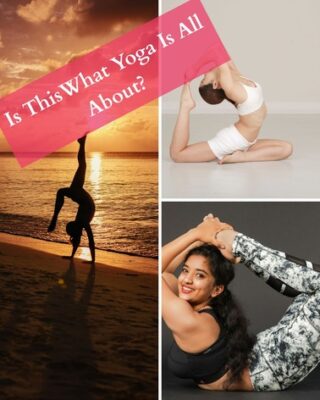
Created on Canva
That’s because of the current, mainstream view of Yoga, which often includes the following:
- Yoga is a fitness modality for health and wellbeing.
- Take a 200 hour teacher training course and that’s all you need to teach Yoga.
- Yoga is a class to do 1-3 times a week to help with strength and flexibility.
- To be ‘good’ at Yoga, means you’re hyperflexible and can perform amazing body contortions.
- If you do some of the techniques for a bit, you should be calm and serene.
These are just a handful of the MYTHS of Yoga out there. If you’re interested, keep reading and let’s unravel what Yoga is truly about.
YOGA IS HOLISTIC AND NON-JUDGEMENTAL
(I will be referencing Yoga texts that were written thousands of years ago. The wisdom in these texts was discovered by the dedicated self-study of ‘Yoga scientists’ called Rishis. They wanted to know how to reduce the suffering of being human. The fascinating thing for me is watching how modern science continues to ‘discover’ the same data that these ancient masters learned just by simply studying themselves).
#1 One thing I love about Yoga is its holistic, non-judgmental view on being human.
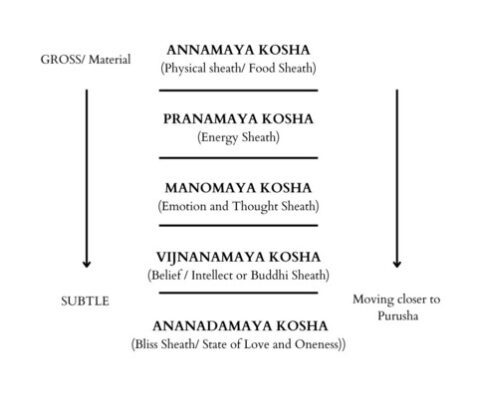
The Panchakoshas are a model of human existence from the Taittiriya Upanishad, a Vedic text from ancient India, listing 5 sheaths or layers:
- Annanmaya Kosha: Food sheath or physical sheath
- Pranamaya Kosha: Energy sheath
- Manomaya Kosha: Emotions and thoughts sheath
- Vijnanamaya Kosha: Intellect and beliefs sheath
- Anandamaya Kosha: Bliss sheath (most subtle aspect of human existence that is closest to our True Self).
This holistic view widens the view on what it is to be human. We aren’t just our physical body. There is much more to us than that. These 5 layers are connected to each other and influence each other. This is empowering. If there is an obstacle on the physical level, it will affect the other layers. And, the other layers, will also influence the physical body. We can use this information to explore how changing one layer can positively shift the other layers. It creates choices and options to make conscious change in our mind-body system.
APPLYING THE PANCHKOSHAS
I recently had my hand shut in a door, which required medical care. (My affected fingers are healing well). When it happened, I had an immediate reaction of pain from my physical layer. As I was assessing the situation, I started to get lightheaded so I sat down and started to talk with myself in a calm, reassuring manner. I acknowledged the pain and reminded myself it was not life or death; My hand would be cared for; I was going to be okay and had good support.
By intervening at the level of my thoughts and emotions, this helped calm and relax my body a bit, as well as turn the volume down on my body’s fight or flight response.
All humans have resources within the 5 layers of what make us human. When we widen our view of what it means to be human, the choices of inner resources we have, empowerment, confidence and courage naturally emerge. Understanding that our fellow humans also possess these resources can also help as we interact with them. It can empower us to move from being stuck in judgment to shift into curiosity about what’s happening in the other person’s reactions.
There’s no need to take what’s happening personally. This person is having a human experience of reaction and we can take action to understand by observing what is happening on the different layers of their existence.
REDUCING YOGA TO A FITNESS CLASS
When Yoga is just reduced to a ‘fitness practice’, it becomes just another strategy for wellbeing. While at face value, that seems like a wonderful thing, it is limiting. If that strategy doesn’t get us what we want, it gets labeled as ‘doesn’t work for me.’ Yes, the strategy of Yoga as presented in this one dimensional way, may not be a fit for you. But this is not the only scope of Yoga. It’s not black and white – it works or doesn’t. It is a path all human beings are on whether they are aware of it or not.
 This word ‘Yoga’ has been attached to a definition in modern times that focuses on typically Annamaya Kosha (physical sheath), and maybe toe dips into Pranamaya Kosha and Manomaya Kosha for moments. This reduction is like looking at a small hole or crack in a wall and seeing a small segment of what’s on the other side. Then, taking what you saw and generalizing it as the whole picture of what’s on the other side of the wall.
So, yes, Yoga can be used as a physical wellbeing practice. But…that’s a drop in the ocean of all that Yoga offers.
YOGA IS A PROCESS OPEN TO ANYONE
#2 Yoga is a process and a lifestyle that requires continuous learning over one’s life. 200 hour teacher training is just the beginning. And you don’t have to teach to receive the benefits of Yoga!
Have you ever listened to a master musician? Someone who seems to effortlessly bring forth amazing sounds from their instrument that makes your heart sing?
That person had a long journey to be able to play masterfully in that moment. Hours, days, months, and years of playing their instrument. Repeating a few notes, playing scales, practicing over and over again. Commitment, frustration, low motivation, high motivation, inspired to keep going. Sacrificing other things to focus on practice. This is what we forget. It’s easy to romanticize that sweet music and write off the dedication involved in creating that moment.
 I am a recreational ukulele player. I am not consistent with it but I enjoy playing when I pick it up. And I love playing with others. As a gift many years ago, my mom got me tickets to see Jake Shimabukuro, arguably the best ukulele player of all time. I was so excited. I was mesmerized by what he could play with a ukulele, how his hands moved, and just seeing his being as part of the music. Awesome.
Later I looked him up to learn more about his journey. Friends shared how he always had his ukulele with him at school and any free moment he was playing it. It was his passion and it guided him forward to many experiences for him to hone his craft. There is a reason he is a master of the ukulele.
PRACTICE, REPETITION, COMMITMENT
With anything in life, commitment, practice, and repetition are essential to find mastery. Let’s even let go of focusing on mastery. These three traits are needed to build any habit and integrate that habit into life so they happen without thinking. There is a process that one has to go through to learn, integrate, and master anything.
All of us have done this with learning how to walk. We weren’t born walking as a human being. It’s a process that starts just by being able to lift our heads. If you can’t lift your head, you can’t walk. Every human that has a body capable of walking has to go through typically an 11 month process just to begin walking. Because you have done this process with walking, you are capable of commitment, practice, and repetition to create any habit.
Yoga is a path of Self-realization. Most of us in the Western world first engage with Yoga through our bodies in a Yoga asana class. For many, that will be their only interaction with Yoga. There will be some who find themselves curious and wanting to know more. Curiousness is part of Yoga. Of those, some will dive into learning more from more skilled Yoga practitioners. Some may stay with it for a while and some continue until Yoga becomes a way of life. None of this is good or bad, right or wrong. I just want you to know that Yoga is more than a class or a training. It is also a way of life that focuses on Self-realization. That process continues until complete understanding of True Self happens.
EFFORT OVER A LONG PERIOD OF TIME
#3 Amazing things happen with repetition and consistency over a long period of time.
I cannot emphasize the importance of repetition and consistency over a long period of time. We live in a modern world that values the complete opposite of this: New = Better, Quick Fixes, Keep moving forward. We have lost the ability to discern for ourselves what works for us and the patience to stick with that to witness change. Instead, we give our power over to influencers, powers that be, and experts to tell us what to like, what to do, how to live.
Those of you who have ‘woken up’ to the realization of choice, questioning your conditionings, and feeling a sense of dissatisfaction with living the status quo, want to reclaim your power. There’s most likely a desire to create a better world and live a more fulfilling life. To make conscious change requires dedicated effort and practice.
But this isn’t a ‘new’ issue for the human mind. In Patanjali Yoga Sutras (PYS), a Yogic text that was written down thousands of years ago, emphasized this same wisdom with repetition and consistency. PYS 1.14 states “Practice becomes firmly grounded when well attended to for a long time, without break and in all earnestness.” This is not easy because the mind, where it stands for most of us, is fickle and easily distracted.
TAPAS – THE COURAGE TO KEEP GOING
 There is a principle from PYS that specifically addresses this: Tapas. In Sanskrit, this word literally means ‘to burn’ or ‘to heat’. The concept of Tapas is to build the courage and fortitude to keep up your practice for the conscious change you desire, even when it gets tough. In fact, that’s the most important time to practice! When we lean into the resistance and do our practice anyways, this is when the practice can really burn away what is limiting us.
Just like a diamond is created from coal due to the pressure of gravity and the layers of earth above it over millennia.. True Nature of Self is revealed with the ‘weight’ of consistent practice, over a long period of time in all earnestness.
This doesn’t just apply to the process of Self-realization. It is true if you are looking to master anything. Again, forget about mastery. Even if you want to form a new habit or create conscious change, this wisdom applies to all levels of change. Practice with repetition, over a long time, with dedication.
THE BODY IS NOT WHO YOU ARE
#4 The body is a doorway, not the end goal. Attachment to the body limits you. The body is always changing and it’s not who you are.
One of the fundamental questions of Yoga is ‘Who am I?’
My Yoga journey started in earnest after I moved halfway across the world to India and found myself still in a miserable state. I had an epiphany after getting upset with my partner, seeing that I was in an amazing place, and I was still reacting. In that moment, I realized my struggles were within, not with anything outside of me. And I began to wonder who it was that was actually miserable.
In point #1, I introduced the Panchakoshas. Those five layers of human existence all exist within the zone of Prakriti. Prakriti is the material word. It is everything that changes, has beginning and end, and is subject to cause and effect. Body, emotions, thoughts, everything you see around you are all in this zone of existence. Yoga’s claim is that since all these things change, they are not the essence of ‘Who I Am.’
The Truth of who each of us is doesn’t change. It is eternal. The Sanskrit word used in PYS to name this True Self is Purusha.
LETTING GO OF ‘GOOD’ & ‘BAD’
An important aspect to remember is that all the resources we have are in the zone of Prakriti. These resources, how they work for us, will change with time. What is a tool that you used when you were younger to feel good? When did it change from helpful to limiting? I sucked my thumb as a child to self-soothe. Then it started to negatively affect my teeth. I had to stop using this strategy to feel better and find another that wasn’t harming my body.
It’s easy to see Prakriti as ‘bad’ and Purusha ‘good, but neither are good or bad. All our resources from Prakriti are there to help us find our way to knowing Purusha. We must use these resources to work towards Self-understanding. The key is to discern what is helpful, what is not, and accept what helps today might not help tomorrow.
ACCEPT THE NATURE OF THE BODY
Our modern day obsession with the body is to keep it looking young forever. We mutilate the body in the name of keeping it young. So much so that I even heard that there are young elementary students who are worrying about their skin – despite having the very skin everyone is chasing after. The body is just another tool. It is a gift we’ve been given in this life and it is our job to care for it. But it will change and that change is also for our benefit even though there is also pain with it.
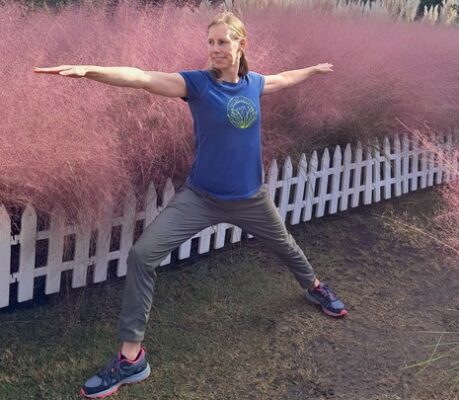 A Yoga Asana class, depending on the teacher and their training, when taught from a traditional Yoga lens, is an invitation to use the body as a resource to turn awareness inwards. To cultivate inner awareness, curiosity, and exploration. But most Yoga Asana classes are focused solely on fitness. Again, this isn’t necessarily ‘bad,’ it’s just limited.
An example of this limitation is the labels of beginner, intermediate, and advanced with a Yoga Asana class. These labels are focused on how fit a body is, how much flexibility, and how much endurance. In my mind, an ‘advanced’ Yogi is one who is able to sit still with a calm mind. Not one who can perform intense poses of strength and contortionism. What happens when the body ages or becomes injured? The body is no longer ‘advanced.’
And most likely the mind is suffering from that loss of identity. One who is mature on the path of Yoga has a steady, calm mind no matter what life brings. That is Yoga.
NOTHING CHANGES IF NOTHING CHANGES
#5 You can know all the techniques in the world…but if you don’t use them, nothing changes.
And finally, you can sign up for all the courses, buy all the books, subscribe to all the podcasts, and ‘like’ all the videos…
But if you aren’t practicing any of it, you will continue to be tossed about in the mire of confusion and suffering.
Look, change will happen to all of us. It’s part of the nature of Prakriti. Everything that can change, will change. But conscious change only happens with intention, practice, discernment, and detachment. (sankalpa, abhyasa, viveka, and vairagya are the words in Sanskrit respectively)
I came into this life with a highly active mind and anxious nervous system. Since I’ve been earnestly on the path of Yoga for over a decade, I have watched my mind distract me over and over. It took me almost 8 years to develop a daily meditation practice I know for certain that I am not able to refine my mind into a calmer, relaxed state alone. I have needed a lot of support. A lovely quote in Yoga about spiritual knowledge is:
“Spiritual knowledge is gained ¼ from Guru, ¼ from Svadhaya, ¼ from Sangha, and ¼ from maturity.”
SOURCES OF SPIRITUAL KNOWLEDGE
Guru is a broad term that I take as anything and anyone who passes spiritual wisdom on to me. I do believe that it’s helpful to have a Guru of some type in human form. And, know that this is not the only form a spiritual teacher comes in. Life is a constant Guru if you are present, listening, and observant.
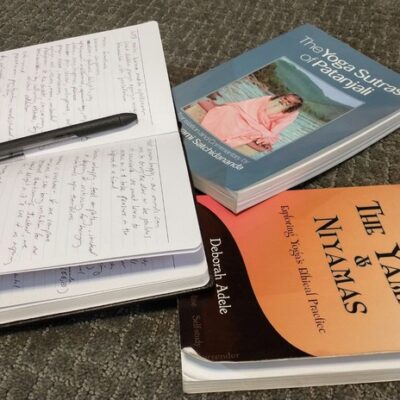 Svadhaya means self-study. In Yogic literature, it means learning about spiritual knowledge from spiritual scriptures and texts. Then, bring that wisdom into your daily life through self-awareness and reflection to see what you discover. I also think that self-study is any form of self-awareness that is explored with curiosity to gain insight and Self-understanding. The key to Svadhaya is self-awareness.
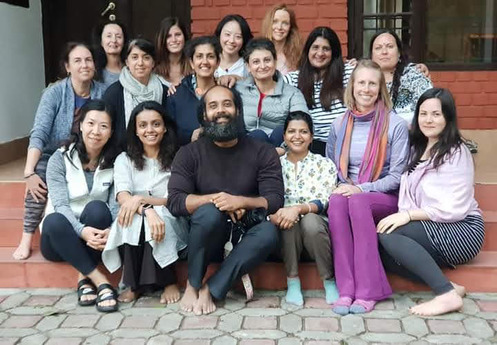
Sangha is a spiritual community of like-minded people who have similar spiritual goals. In the Western world, a church is usually thought of as a common place for spiritual community. For me, a Sangha is a space where I can show up honestly, as is, and be supported, encouraged in an honest, compassionate way.
 Finally, maturity – which is simply time. Just by living and going through the aging process of the human body will bring about wisdom naturally. This is an important point to remember because we are conditioned to striving and forcing ourselves to be better. When in reality, not all spiritual wisdom can be taught, it has to be experienced over time. A question I’ve been exploring for some time is ‘How much effort is actually necessary? Where is effort best applied with conscious change?’
REFLECTION
If you’ve read through this blog, I’m impressed! That was a lot of information I put out there. I’m curious, what resonated with you? Which of the 5 points did you agree with and which did you feel resistance towards? Explore both!
In the near future, I am going to be switching up access to my blog posts to support those interested in deepening Self-exploration through Sangha, Svadhaya, and Guru. If this might be something that interests you, let me know by clicking on this link so I can make sure to contact you when this change happens. No pressure at all! It is helpful for me to know how much interest there is with my blogs and building community.
 Shanti.
Connect with Twyla at Samya Yoga Healing’s ‘home.’
(Top photo by Wendy Griffith Photography)