
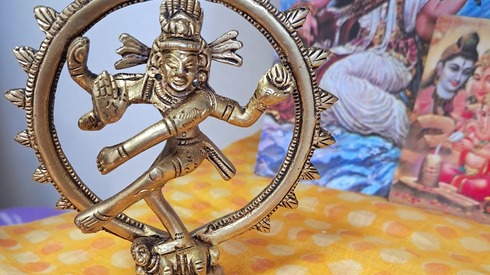
One of the statues that sits in my altar is of Nataraja, Dancing Shiva. There is a ring of fire around the dancing Shiva, wo is standing on top of a human being. The fire represents destruction as Shiva is the Lord of Destruction. This destruction is specifically towards all that limits human nature from knowing the Truth of ‘Who I Am.’ In the wilderness, cycles of fire are necessary to clear away dead debris, open up space for new plants, and create enough heat to burst open some seeds that are reliant on intense heat to start their life cycle. In order for the mind to transform, it needs the ‘heat’ of change and challenges to burn away what keeps us knowing our True Nature, much like fire burns forest to continue a healthy ecosystem. Tapas is the practice of self-discipline to stand in the heat of life.
“It is in this barren place, where we have exhausted all that we have and all that we are, that new strength is shaped and character is born if we choose to fearlessly open ourselves to the experience. It is perhaps the greatest gift life could offer.” – Deborah Adele

Tapas is one of the Niyamas, five observance practices from Patanjali Yoga Sutras. Its literal translation is “heat.” The practice of tapas is burning away what is not true or what is impermanent for self-purification. In this practice, we must accept that pain is a part of life and not something to avoid or escape from, but rather something to move towards and through.
The practice of being with pain, specifically emotional pain, it allows us to learn, discover, and gain self-understanding. In doing so, the pain decreases or even completely dissipates. Pain ends up being one of our greatest teachers.
Typically, what we are taught to do, and what the mind/body system is inherently wired to do, is the opposite of tapas. The mind wants to avoid all pain at any cost possible. There are times when we need to do this, like life or death situations. If your house is on fire, you need to get out. If a person is physically attacking you, you need to protect yourself and get to a safe place. Yet, the majority of daily situations are not life or death. Yes, they may feel hard or challenging, but avoiding the emotional pain ends up actually increasing suffering and pain rather than decreasing it. If you have ever felt stuck in life, most likely it is because of avoidance of yourself on some level, which keeps you from moving through and forward.
Procrastination is an avoidance behavior. It happens when you don’t feel like putting in the effort of doing a task. Not wanting to deal with another person’s reaction, i.e. avoiding a conflict, is another example. Worried how others might perceive you, so you don’t listen to your heart and do what feels right. Not wanting to deal with pain from the past so you have another drink, another smoke or harm yourself in another way to numb out. These are all examples how humans work hard to avoid facing themselves to move through difficult emotions.
To change any of these behaviors takes self-discipline to do it differently when you are in the fire of emotions.
IT’S ON US…THE PRACTICE OF SELF-DISCIPLINE
Self-discipline is a major part of tapas as it keeps us focused when the going gets tough or the heat is turned up.

Photo from Unsplash
I witnessed a lack of self-discipline take over many families this spring when stay at home orders happened. Many parents who struggled with how they were feeling had a hard time supporting their children’s reactions. It felt ‘easier’ to let go of boundaries, routines in this challenging time. Yet, these behaviors fueled anxiety and depressive symptoms instead of helped. As kids are to gearing up to be back in school in some form this fall, I think it’s imperative to face and name the avoidance behaviors to decrease their power. The mind is tricky. It is wired to avoid pain, even perceived pain. But in the end it increases suffering. The exact opposite of what we truly want.
What is the mind’s trickery? It’s the mind’s excuses, stories that aren’t true, blaming and shirking responsibility, the self-defensive and self-defeating thoughts.
ROUTINE
I had one friend share, “The first week of staying at home happened during spring break, so we (their family) treated it like spring break. Staying up late, no routine, drinking every night, living it up. After a week of this, feeling tired and run down, we realized we can’t keep this up. This could get real bad real quick.”
So, they got back into a routine with online schooling and online working. My friend made sure to dress for work, even though she was just going across the hall. Everyone was expected to do their work during work and school hours. Eating meals at the same time. Making exercise a priority. The positive with this was during free time, the four of them did fun and creative things together because they had energy, were grateful for the free time, and actually needed it as a break from ‘work.’ My friend shared, “we connected in ways we never would have before because we were always on the go.”

Photo From Unsplash
What basic self-discipline method this family had was ROUTINE. The families I heard about that had family members struggling had one thing in common…lack of or no routine. Extreme cases were going to bed when it’s daytime and awake at night. This led to no exercise, more screen time, not eating regularly or nutritious meals, and ultimately feeling depressed and without purpose, totally lost.
Those of you who identify with lack of routine and the struggles it created, please, take time to reflect and learn from this ‘experiment.’ This is where self-discipline comes in, whether as a parent or family system. Ask yourself this:
- What do I want things to look like as my child goes back to school (as there will be some form of online schooling most likely happening at some point this school year)?
- What didn’t go well the first time around?
- What can I do differently and help my children do differently to help them be successful? (And decrease my stress level too).
Have a conversation with your children and have them answer these questions as well so the whole family helps to figure out a different plan. If your children are involved and have buy in, it will be much easier to keep coming back to this plan and hold each other accountable. Create a routine for Monday – Friday as a family and stick to it!
BE REAL HONEST
As a parent, OWN YOUR PART in what did not go well. Is it hard for you to set a boundary and stick to it? Is it easy for your kids to wear you down so you give into their wants and desires? What self-destructive behaviors have you been doing that keep you from being present with your kids? (HINT: excessive alcohol or drug use or excessive screen time)?
If you need help with figuring this out, connect with professionals who can help support you in making the changes needed. Asking and accepting help is an important tapas practice.
Be honest with yourself isn’t easy. Most of us have been taught to put others first and discount ourselves. But it is very important. Otherwise, the mind will take advantage of you. It will pile on excuse after excuse as to why you should just abandon all efforts. Ultimately this will lead you right back to all those negative behaviors and consequences.
CREATE YOUR VILLAGE

Photo From Unsplash
The other part of being in the heat of it is making sure you have a good support system. Feeling alone and isolated is another challenge that happens with lack of routine and stay at home orders. Take time to find other families who are committed to the discipline of sticking to a routine no matter what changes and support each other. Talk about the struggles, get support and support others.
There’s a reason for the saying, ‘It takes a village to raise a family.’ Create your village!
Just starting with these three steps – Create and stick to a routine; Be real honest; and Create your village – will do wonders to meet the fires life will throw at us. They will do wonders for mental health and keeping yourself thriving versus sinking. We all deserve to thrive and enjoy life.
 Shanti.